Explore how low-dose oral minoxidil can help address hair loss and balding concerns. This article explains how personalized dosing and compounded formulations may improve hair regrowth results and minimize side effects, offering tailored support for individuals seeking effective hair restoration strategies.
Addressing Hair Issues and Hormonal Imbalance
There are medications that may help slow hair loss and regrow hair; without them, the hair loss will continue.
Low Dose Oral Minoxidil (LDOM)
Low Dose Oral Minoxidil (LDOM) was recently featured in a NY Times article, which caused many doctors to take notice.
For patients in studies, it improved the thickness and overall hair volume. Patients may prefer oral minoxidil to topical therapy because it is easy, and topical therapies often have a combination of drugs that “may” be irritating to the scalp, messy or inconvenient. Patient compliance with topical medications may be an issue because of the necessity to use a liquid medication twice a day to the scalp area, leading to undesirable hair texture and possible scalp irritation.
For prescribers, please see the article “Coming full circle (almost): Low dose oral minoxidil for alopecia” by Dermatologist Warren R. Heymann, MD, FAAD, which features some systematic reviews of LDOM for alopecias. Read article »
“Low” dose oral minoxidil referred to in the studies regarding hair loss is not manufactured commercially and, therefore, depending on the strength prescribed must be compounded.
Oral minoxidil is manufactured commercially (available at chain retail pharmacies) only in 2.5 mg, 5 mg, and 10 mg strengths.
Commonly prescribed compounded strengths of Low Dose Oral Minoxidil (LDOM)
0.25 mg, 0.5 mg, 0.625 mg, 0.75 mg, 1 mg, 1.25 mg, 1.5 mg, 1.75 mg, 2 mg, 2.25 mg, 2.5 mg capsules
Literature regarding the dose of oral minoxidil for women vs men suggests that women use lower doses, from 0.25 to 2.5 mg daily, and men need higher doses for maximum efficacy, from 1.25 to 5 mg daily.
(Source: Review of oral minoxidil for addressing hair disorders: in search of the perfect dose)
In another article, the authors suggested a dosing regimen based on response and tolerability:
- Females: Starting dose of 0.5 mg/day followed by 0.25-mg increments every 3 months up to a maximum dose of 2.5 mg/day.
- Males: Starting dose of 2.5 mg/day followed by 1.25-mg increments every 3 months up to a maximum dose of 5 mg/day.
(Source: Low-Dose Oral Minoxidil Deemed Safe for Hair Growth)
Common Compounded Topical Combination Rx’s in Hair Loss
Prescribers, talk to our pharmacists about options. Town & Country Compounding has various formulations that are requested for both men and women who experience hair thinning or hair loss.
Topical minoxidil is commercially available OTC as a liquid and foam at 2% and 5% concentrations. Often, people do not get the results they are hoping for with this, so doctors often prescribe a compounded formula with higher strengths of minoxidil or a combination product with minoxidil and two or three other drugs.
Formulas can be compounded in various combinations and concentrations:
Minoxidil + finasteride
Minoxidil + finasteride + biotin
Minoxidil + finasteride + estradiol
Minoxidil + tretinoin
Minoxidil + tretinoin + finasteride + progesterone
Minoxidil + azelaic acid
Minoxidil + azelaic acid + tretinoin
Minoxidil + azelaic acid + tretinoin + tea tree oil + melatonin
*Adding latanoprost to a formula is typically cost-prohibitive.
- Efficacy of Topical Combination of 0.25% Finasteride and 3% Minoxidil Versus 3% Minoxidil Solution in Female Pattern Hair Loss: A Randomized, Double-Blind, Controlled Study. https://pubmed.ncbi.nlm.nih.gov/30206824/
- Is Minoxidil Really a Miracle Cure for Baldness? (oral). https://nymag.com/intelligencer/2022/09/is-minoxidil-really-a-miracle-cure-for-baldness.html
Hair loss happens in both men and women
Androgenetic alopecia (AGA) is the most common form of alopecia in both males and females. Alopecia is the loss of hair (or lack of hair) on areas of the body where hair is usually present.
Even though our society is more accustomed to talking about baldness in men, hair loss is a common occurrence and an important cosmetic concern for both men and women. Hair loss can be caused by hereditary genes, aging, medical conditions, hormonal imbalances, medications, stress, etc.
Male pattern baldness / Female pattern baldness (Androgenetic Alopecia)
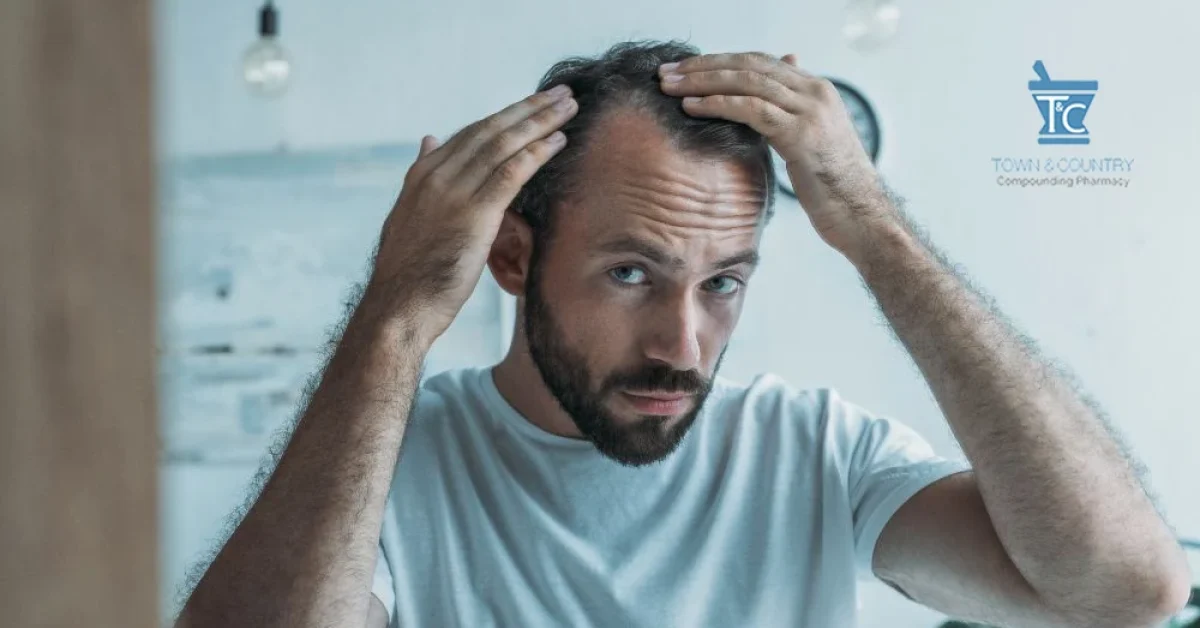
Both men and women can develop hereditary hair loss, called male (or female) pattern hair loss or androgenetic alopecia (AGA). Genes cause the hair follicles to shrink, eventually leading to hair loss. With male (or female) pattern hair loss, men start to notice receding hairline and/or hair loss at the top of the head. Women start to notice overall thinning in their hair and a widening part.
Also, even if patients do not have hereditary genes that cause hair loss, it is natural for hair growth to slow down and hair to thin. Hair loss is especially distressing for women since it is not as commonly seen or expected.
Alopecia areata
Alopecia areata is an autoimmune condition in which the immune system attacks the hair follicles. Hair loss can occur all over the body, including loss of eyelashes and eyebrows.
Hormonal changes
When estrogen and progesterone levels decline in women, androgen levels may increase, which can cause thinning of the hair. If your hair loss is caused by hormone imbalance, correcting the imbalance can help with hair growth.
- Hair Loss: Who Gets and Causes. https://www.aad.org/public/diseases/hair-loss/causes/18-causes
- Menopause Hair Loss Prevention. https://www.healthline.com/health/menopause/hair-loss